5 Frame Checkpoints That Instantly Improve Your Ballroom Hold
Quick Answer: Shoulder blade engagement, elbow height, core lift, neck lengthening, and connected arm tension are the 5 checkpoints that most directly fix a collapsing ballroom frame, and running through them before dancing catches issues before they show up mid-step.
A frame that collapses under partner connection or during turns usually isn’t a single big mistake — it’s one of these five specific checkpoints slipping, often without the dancer noticing until a coach points it out.

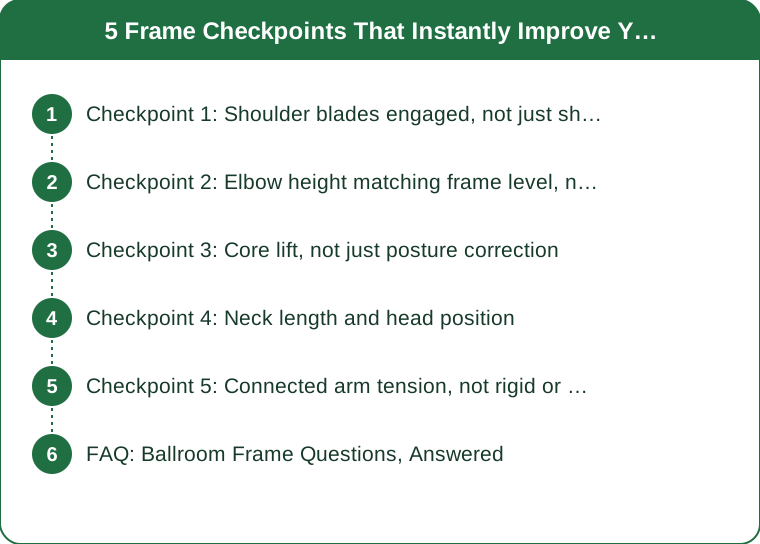
Checkpoint 1: Shoulder blades engaged, not just shoulders down
“Shoulders down” alone isn’t enough — actively drawing shoulder blades slightly together and down creates the stable back engagement a frame needs. Shoulders pulled down without this engagement often look correct but collapse the moment partner weight or turning force is applied.
Checkpoint 2: Elbow height matching frame level, not drooping
Elbows should stay at roughly the same height as your frame throughout movement — drooping elbows mid-dance is one of the most common, least self-noticed frame breakdowns, especially during turns when attention shifts to footwork.
Checkpoint 3: Core lift, not just posture correction
A genuinely lifted core (think: a string pulling up from the crown of your head, engaged lower abdominals) supports the frame from below, whereas posture correction focused only on the shoulders and back leaves the frame unsupported from its actual foundation.

Checkpoint 4: Neck length and head position
A shortened, tense neck telegraphs tension through the entire frame above the waist. Consciously lengthening the neck (without lifting the chin unnaturally) is a small adjustment with an outsized effect on how stable and elegant the whole frame reads.
Checkpoint 5: Connected arm tension, not rigid or floppy
Arms need consistent, moderate tension — floppy arms fail to transmit lead-and-follow signals clearly, while overly rigid arms fight the movement instead of channeling it. This is the checkpoint that takes longest to feel correctly and benefits most from a coach’s direct feedback.
FAQ: Ballroom Frame Questions, Answered
Why does my frame collapse specifically during turns?
Turns add rotational force that exposes any weak checkpoint immediately — most commonly elbow droop or insufficient core lift, since both are easy to maintain standing still but harder under rotation.
How long does it take to build a stable frame as a beginner?
Most dancers see noticeable frame stability improvements within 8-12 weeks of consistent practice and instructor feedback — frame is a strength and habit skill, not a one-lesson fix.
Can I practice frame checkpoints without a partner?
Yes — practicing frame position and the 5 checkpoints in a mirror, even without a partner or music, builds the muscle memory that partner work then tests and refines.
TL;DR:
- Shoulder blade engagement, elbow height, core lift, neck length, and arm tension are the 5 frame checkpoints
- Turns expose weak checkpoints fastest, especially elbow droop and low core lift
- Practice checkpoints solo in a mirror before testing with a partner
- Expect 8-12 weeks of consistent practice for real frame stability
Run the five checkpoints before you dance, not just when a coach corrects you mid-step.
Keep Reading
This article is for general informational and styling purposes only. Fit, sizing, and product availability may vary.