Five Practice Setups for the Indoor Ballroom Season
Quick Answer: Most dancers have exactly one practice mode — the weekly lesson — and it’s the least efficient one for building skill. Five different setups solve five different problems: studio time for partnering, a small hard floor for footwork, a mirror for shape, solo drills for technique you can’t fix with a partner watching, and a social night for the pressure test. Autumn is when all five become available at once.
Summer ballroom is patchy. Studios empty out, socials thin, and everyone’s travelling.
September brings all of it back at the same time, and it’s genuinely the best block of the year to improve — a long uninterrupted stretch before the holidays. Here’s how to use five different practice environments rather than one.
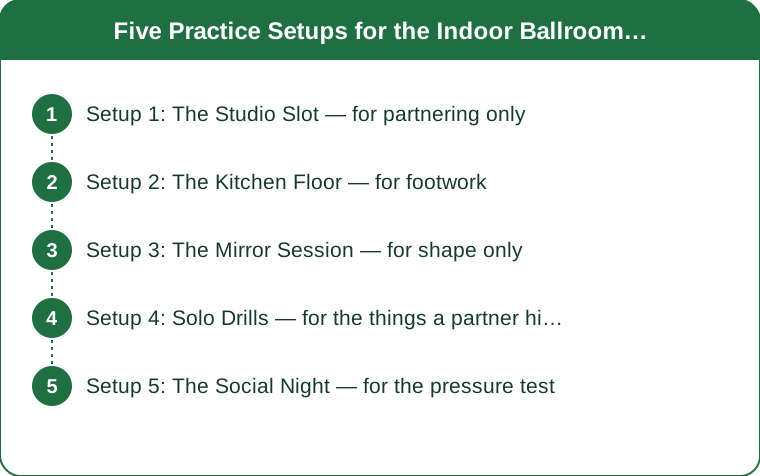
Setup 1: The Studio Slot — for partnering only
Floor time with a partner is the scarcest and most expensive resource you have, so it should be spent exclusively on the things that require both.
What belongs here:
- Connection and lead-follow — the actual information transfer through the frame, which cannot be practiced alone in any meaningful way.
- Floorcraft and navigation, which needs the real floor and other couples.
- Timing together, especially the small negotiations of a shared rise and fall.
- Choreography and routine work.
What does not belong here: your own footwork, your own posture, memorizing a step sequence you could have learned at home. Every minute spent on solo-fixable material is a minute of partner time thrown away.
How to make it count: arrive knowing your material. Agree on two things to work on before you start, not eight. And record one pass on a phone at the end — a single 90-second clip is worth more for the next week’s solo practice than an hour of vague memory.
On booking: studio time gets scarce from October. If you want a regular slot, arrange it in the next two weeks.
Setup 2: The Kitchen Floor — for footwork
A small hard floor is enough for a surprising amount of real practice, and it’s the setup that fits into an actual weekday.
Where: any hard, smooth surface — kitchen, hallway, a cleared patch of wood floor. Roughly six feet by six feet is enough. Carpet is the enemy; it hides everything your feet are doing and prevents proper foot pressure.
What to practice here:
- Foot rolling and pressure. Heel-to-toe in a slow walk, feeling the whole foot. This is the foundation of smooth movement and almost nobody drills it.
- Basic figures without a partner, slowly, at a fraction of tempo.
- Weight transfer. Standing on one foot, transferring fully, standing on the other. Deceptively hard and directly relevant.
- Ankle and foot strength — rises, controlled lowers, single-leg balance.
Duration: ten minutes. Genuinely. Five days of ten minutes beats one session of an hour, because footwork is a motor skill and motor skills consolidate with frequency.
Footwear: practice shoes or socks on a smooth floor. Not sneakers, which prevent the foot from articulating and teach the wrong pressure entirely.
Setup 3: The Mirror Session — for shape only
A different kind of practice, and it needs a rule: the mirror is for checking, not for dancing.
Dancers who practice constantly in front of a mirror develop a habit of looking at themselves, which shows up on a floor with no mirror as a wandering head and a broken frame. So use it deliberately and in short bursts.
What to check:
- Frame. Elbows, shoulder height, the line from your hand through your arm to your back. Hold the position, look, correct, look away, hold again, then look to see if the correction held.
- Head and neck position, which is the most commonly wrong and the most visually important element.
- Posture through the ribcage — the difference between a lifted torso and a leaned-back one is invisible from inside and obvious in the mirror.
How to run it: set a shape, close your eyes, feel it, open your eyes and check. The goal is to build the internal sense of the correct position so you don’t need the mirror. Checking with your eyes open the whole time teaches you nothing transferable.
Ten minutes, twice a week. More than that and you’re building a mirror dependency.
Setup 4: Solo Drills — for the things a partner hides
The most valuable practice setup and the one almost nobody uses, because it feels less like dancing.
A partner masks a lot. You can be badly balanced and stay upright because you’re leaning on someone. You can have poor foot pressure and get away with it because the momentum comes from elsewhere.
What to drill alone:
- Your own balance through every step, without contact. If a figure falls apart when you do it alone, it was never yours.
- Rotation. Turning cleanly on your own axis, controlled, is a skill entirely separate from turning with a partner.
- Rise and fall, which needs to be your own action and not a response to someone else’s.
- Musicality. Listen to the music you dance to and move to it freely, without figures. This is the single most underrated practice and the fastest route to looking like you’re dancing rather than executing.
A specific drill worth doing: run your basic figures at half tempo, alone, with your eyes closed. Everything that’s being carried by your partner or by momentum will fall apart immediately, and what falls apart is your actual homework.
Fifteen minutes, twice a week, and it will change more than the lesson does.
Setup 5: The Social Night — for the pressure test
The last setup isn’t practice, and it’s the one that tells you whether the other four are working.
What a social provides that a lesson can’t:
- Unfamiliar partners, which is the only real test of whether your lead or follow is clear or whether you and your regular partner have just memorized each other.
- A crowded floor, which is where floorcraft becomes real.
- Music you didn’t choose, at tempos you didn’t pick.
- No stopping to fix things. You dance through the error, which is a skill in itself.
How to use it well: pick one thing to think about for the night — your frame, your foot pressure, your posture — and let everything else be whatever it is. Trying to apply five corrections on a social floor produces a stiff, anxious dance and no learning.
Dance with people better than you at least twice, and with beginners at least twice. The first teaches you what clear connection feels like; the second exposes exactly how much you’ve been relying on your partner covering for you.
On the season: social calendars fill out from late September through December, then go quiet in January. This is the dense part of the year — the pressure testing is available now in a way it won’t be in six weeks. Go while it’s there.
TL;DR:
- Studio time is for partnering only — connection, floorcraft, timing. Never spend it on solo-fixable material.
- A six-by-six hard floor and ten minutes a day handles footwork. Frequency beats duration for motor skills.
- The mirror is for checking, not dancing. Set the shape, close your eyes, feel it, then verify.
- Solo drills at half tempo with eyes closed expose everything your partner has been covering.
- Socials are the pressure test — unfamiliar partners, crowded floors, one thing to focus on per night.
All five are available right now and three of them won’t be by January. This is the block that makes the season.
Keep Reading
This article is for general informational and styling purposes only. Fit, sizing, and product availability may vary.