5 Ways to Get More Out of a Group Ballroom Class When You Arrive Alone
Quick Answer: Most group ballroom classes rotate partners, and arriving alone is both common and often an advantage - rotating dancers get more varied practice than fixed pairs and improve their lead-following adaptability faster. Five things make it work: arrive early and speak to the teacher, learn both roles if the class allows, treat every rotation as a fresh start rather than carrying the last one, communicate briefly and kindly, and know how to decline or exit a partnership gracefully. The awkwardness lasts about two classes.
You want to learn to dance. You do not have a partner. Everyone tells you that is fine, which is true, and does absolutely nothing for the feeling of standing at the edge of a studio watching people who already know each other.

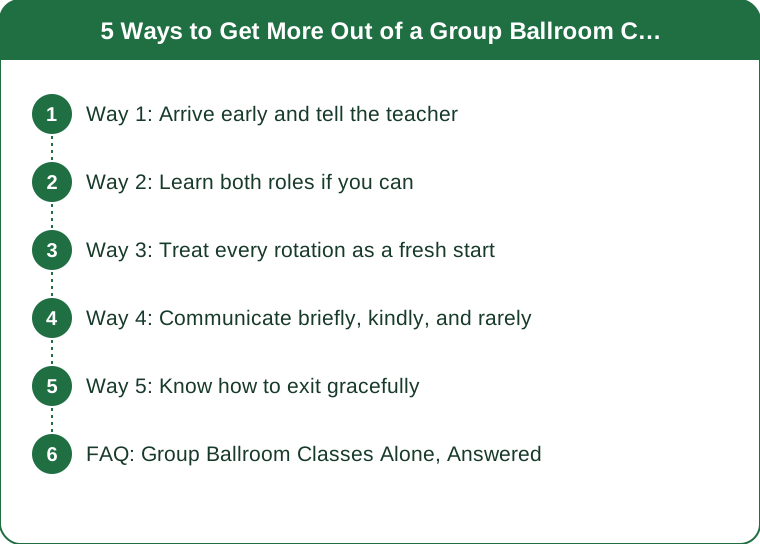
Way 1: Arrive early and tell the teacher
Ten minutes early changes the whole experience. You get a chance to speak to the instructor, get a sense of the room before it fills, and avoid walking into a class already in formation - which is the single most uncomfortable version of arriving alone.
Tell the teacher you are on your own. They will place you in the rotation, and they will usually keep an eye on whether the numbers are working. This is completely routine information for them and it is the fastest way to stop worrying about it.
Ask how the rotation works in this particular class. Some rotate every few minutes, some every exercise, some let established couples stay together. Knowing the system removes most of the uncertainty.
Ask about the balance of leads and follows too. Most social dance classes have more follows than leads, which affects how much dancing time you get and whether learning both roles would help.
And introduce yourself to one person. One is enough. Standing alone in a room where you know nobody is meaningfully different from standing next to someone whose name you know, and it takes twenty seconds.
Way 2: Learn both roles if you can
Learning to lead as well as follow is the single biggest advantage available to a solo dancer. In classes with unequal numbers - which is most of them - being able to fill either role means you dance every exercise instead of sitting some out.
It also makes you a better follower, and quickly. Understanding what a lead is actually trying to communicate changes how you interpret it. Many experienced follows describe learning to lead as the thing that most improved their following.
Start with the role you came for and add the other gradually. Trying to learn both simultaneously from day one is confusing. A few months in, ask the teacher if you can try the other side occasionally.
Ask whether the class is open to it. Most modern social dance classes are entirely comfortable with anyone learning either role, and some teach it as standard. A few traditional settings are less flexible - it is worth asking rather than assuming either way.
And it doubles your practice options outside class, because you can practice with anyone regardless of what role they dance.
Way 3: Treat every rotation as a fresh start
The rotation is the point, not an inconvenience. Dancing with many partners exposes you to different heights, frames, timing, and levels of clarity - which is exactly the variety that builds real adaptability. Fixed couples frequently develop a shared set of habits that only work with each other.
Do not carry a difficult rotation into the next one. If a partnership was awkward, that information ends when the rotation does. Starting the next one braced for the same problem is how one bad three minutes turns into a bad class.
Expect a wide range of experience levels. Some partners will be far more experienced than you and some far less. Both are useful - the experienced ones show you what clear leading or following feels like, and the newer ones force you to be more precise because nothing is being covered for you.
Assume nothing about what went wrong. In partner dancing, an error is genuinely ambiguous - it can come from either side, and even experienced dancers frequently misattribute it. Not diagnosing it in the moment is both kinder and more accurate.
And notice what you learn from each one. The partner who was hard to follow taught you something about how much you rely on visual cues. The very tall one taught you about frame height. Every rotation has content in it.

Way 4: Communicate briefly, kindly, and rarely
A short greeting at the start of each rotation does a lot. Name, quick smile, and go. It takes three seconds and it changes a stranger into a person you are dancing with.
Keep in-dance commentary minimal. Mid-exercise coaching from a partner is one of the most common complaints in group classes, and it is almost never welcome unless asked for. If something is not working, keep trying it or wait for the teacher.
Say thank you at the end of each rotation. It is the convention in social dance and it closes the interaction cleanly, which matters when you are about to move on to someone else.
If something is physically uncomfortable, say so immediately and simply. A grip that hurts, a hold that is too tight, or being pulled off balance - a straightforward that is a bit tight for me is entirely appropriate and most people will adjust immediately and without offense.
And speak up to the teacher rather than the partner about technique. Teachers are there to correct; partners are there to dance. Routing corrections through the teacher keeps the partnership comfortable and gets you a better answer.
Way 5: Know how to exit gracefully
You are allowed to decline a dance. No thank you, without explanation, is a complete and acceptable answer in social dance settings - and it applies in class rotations too if a partnership is genuinely uncomfortable.
If someone is holding too tightly or standing too close, adjusting is your right. Reset your own frame, step back to a comfortable distance, and continue. Most of the time it is unawareness rather than intent, and a physical adjustment communicates it without a conversation.
If something is genuinely inappropriate, tell the teacher or organizer. Good studios take this seriously and want to know. You are not being difficult by raising it, and the alternative is that it continues with someone else.
Leaving a class you do not enjoy is also an option. Not every class or teacher suits every person, and trying a different studio is normal rather than a failure. The atmosphere of a social dance class varies enormously between venues.
And give it more than one class before judging. The first class alone is uncomfortable for almost everyone, and the second is noticeably easier. Most people who describe their dance class as friendly and welcoming felt exactly the way you feel now on their first evening.
Bring proper shoes by class two or three. It is the clearest signal you intend to keep coming, both to yourself and to the room, and it makes everything physically easier.
FAQ: Group Ballroom Classes Alone, Answered
Can I take a ballroom class without a partner?
Yes - most group classes rotate partners and expect solo attendees. Tell the teacher when you arrive so they can place you in the rotation, and ask how the rotation works in that particular class.
Is it better to learn to lead or follow?
Start with the role you came for, then consider learning the other. Being able to dance both means you dance every exercise regardless of the class’s gender balance, and learning to lead is one of the fastest ways to improve your following.
What if I get a partner who is much better or much worse than me?
Both are useful. Experienced partners show you what clarity feels like, and newer ones force you to be precise because nothing is being covered for you. Treat each rotation as a fresh start rather than carrying the last one forward.
Can I say no to dancing with someone?
Yes. No thank you without explanation is a complete answer in social dance, and if something is physically uncomfortable you can adjust your frame or step back without a conversation. Anything genuinely inappropriate should go to the teacher or organizer.
TL;DR:
- Arriving alone is normal and often an advantage - rotating through many partners builds adaptability that fixed couples do not develop.
- Arrive ten minutes early, tell the teacher you are solo, and ask how the rotation works in that class.
- Learning both roles means you dance every exercise regardless of the class balance, and learning to lead makes you a better follow.
- Keep communication to a greeting and a thank you; route technique questions to the teacher rather than your partner.
- You can decline a dance, adjust an uncomfortable hold, and raise anything genuinely inappropriate with the organizer.
The awkwardness of walking in alone lasts about two classes. Almost everyone who now describes their dance class as welcoming stood exactly where you are standing on their first evening.
Keep Reading
This article is for general informational and styling purposes only. Fit, sizing, and product availability may vary.