5 Connection Checkpoints That Fix Most Partner Dance Problems
Quick Answer: Five checkpoints cover nearly every connection problem in partner dancing: tone in the arms without grip, contact at the same point on both sides, weight fully committed on one foot at a time, matched compression or tension in the hands, and eyes and head position that do not disturb the frame. When a figure repeatedly fails, run these five before drilling the footwork again - the footwork is usually correct and the information is simply not travelling between you.
You can dance the figure alone perfectly. With a partner it collapses in the same place every time. That gap is not a memory problem.

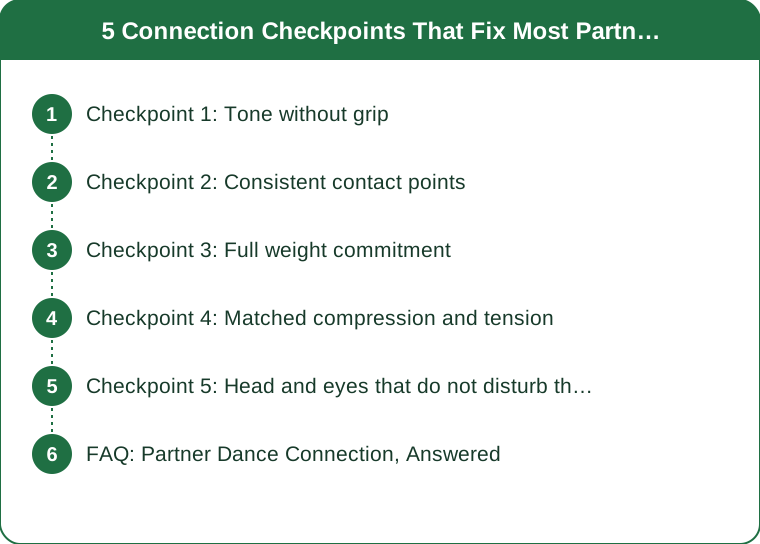
Checkpoint 1: Tone without grip
What it means: Your arms need enough muscular tone to transmit movement, and no more. Too little and a lead disappears somewhere between the hand and the shoulder. Too much and the connection becomes rigid, so both partners feel pushed rather than led.
How to test it: Stand in hold and have your partner move slowly forward. Their movement should reach your body without your arms changing shape and without you being shoved. If your arms fold, there is not enough tone; if you are physically displaced before you can respond, there is too much.
The common error for followers: relaxing the arms entirely in an effort not to backlead. Soft arms do not transmit information, so the lead genuinely arrives late.
The common error for leaders: gripping the follower’s hand or back to force a movement. Grip produces resistance rather than clarity, and it is uncomfortable enough to make people not want to dance with you.
The mental image that helps: think of the arm as a firm spring rather than either a rope or a rod. It holds shape under load, and it gives slightly.
Check it fresh and check it late. Tone deteriorates as people tire, and the collapse of the frame in the third dance of the evening is one of the most predictable things in a ballroom.
Checkpoint 2: Consistent contact points
What it means: In closed hold, the points of contact - the follower’s left hand on the leader’s upper arm, the leader’s right hand on the follower’s back, the joined hands - should stay in the same place throughout. Sliding contact means information is being lost.
How to test it: Dance a simple figure slowly and notice whether the leader’s right hand stays put on the follower’s back or migrates. Migration is extremely common and it makes every subsequent lead less clear.
Why it matters more than it seems: The body contact points are the primary channel for leading in smooth dances. If the hand slides, the lead arrives through the arm instead, which is a much less precise channel and produces the arm-yanking that beginners complain about.
Placement matters. The leader’s right hand generally sits on the follower’s back below the shoulder blade, not on the ribs and not up near the neck. Different styles and syllabi vary slightly, so follow your teacher’s placement.
Both sides matter equally. Followers often focus on the joined hand and neglect the left hand on the leader’s arm, which is actually the point that helps maintain the frame’s shape.
And contact should be steady, not variable. Increasing and decreasing pressure at random is read as a signal, so inconsistent contact produces leads that were never intended.
Checkpoint 3: Full weight commitment
What it means: At any given moment your weight should be entirely on one foot, not split between two. Divided weight is the single most common cause of feeling heavy to a partner or of being unable to follow a change of direction.
How to test it: Freeze mid-figure and try to lift the non-supporting foot completely off the floor. If you cannot, or if you wobble noticeably, your weight was split.
Why it wrecks leads: A lead into a new direction requires you to be able to move the free foot. If that foot is carrying weight, you have to first transfer, which introduces a delay that reads as being late or as resisting.
It also makes you feel heavy. Divided weight means your partner is effectively moving a body that is anchored in two places, which is exactly the sensation people describe when they say a partner feels heavy despite being physically light.
Practice it alone. Walk very slowly across a room, pausing on each step with the free foot lifted an inch. Thirty seconds of this before a lesson does more for connection than most drills.
And be particularly careful on the closing steps. Figures where the feet come together are where weight most often ends up split, and where the next lead most often fails as a result.

Checkpoint 4: Matched compression and tension
What it means: Different leads travel through different types of connection. A movement toward your partner travels through compression - a gentle pressure. A movement away travels through tension - a gentle stretch. Both partners have to match the type and amount for the information to arrive.
How to test it: Have the leader slowly compress and then slowly stretch the connection while stationary. The follower should feel a clear, distinct difference between the two, and should be able to say which is happening with their eyes closed.
The classic mismatch: the leader offers compression and the follower absorbs it by collapsing the arm. The information never reaches the follower’s body, and both people conclude the other one is at fault.
Amount is style-dependent. Latin and swing dances generally use more visible tension and compression than smooth ballroom, which relies more on body contact. Match what your teacher and your style call for rather than importing it from a different dance.
It is a conversation, not a broadcast. Followers maintain their side of the connection actively, which is why good following is not passive and why the phrase back-leading gets misapplied to what is actually just competent connection.
And matching is more important than the absolute amount. Two dancers with a light connection who match each other will dance together far better than a firm leader and a soft follower.
Checkpoint 5: Head and eyes that do not disturb the frame
What it means: In closed hold, head position is part of the frame. Dropping the head to look at the feet shifts your center of mass forward and changes the whole connection, which your partner feels immediately.
How to test it: Dance a familiar figure while deliberately looking down, then again with the head up. The difference in how the connection feels is usually startling, and it is almost always the looking-down version that produces the collapse people blame on their footwork.
Where to actually look: In smooth ballroom, generally over the partner’s right shoulder with the head slightly left, following your teacher’s specific direction for the style. In Latin and swing, eye contact is more common and more direct.
Why looking down is such a strong habit: People look at their feet when they are unsure of the step. It is a confidence problem expressing itself as a technique problem, which is why simply being told to keep your head up rarely works on its own.
The fix is to make the figure easier, not to try harder. Slow the music, simplify the sequence, and practice until you can do it without visual confirmation. The head comes up on its own once the feet are certain.
And in fast turns, spotting matters. Failing to spot in continuous turns causes dizziness, and a dizzy partner disrupts a frame considerably more than a slightly imperfect step does.
If you have neck, shoulder, or back problems, discuss frame and hold positions with your teacher and, if relevant, a physical therapist. This is general information, not medical advice.
FAQ: Partner Dance Connection, Answered
Why can I dance a figure alone but not with a partner?
Almost always because the connection is not transmitting the information rather than because you have forgotten the steps. Check arm tone, consistent contact points, full weight commitment, matched compression and tension, and head position before drilling footwork again.
What does it mean to feel heavy to a dance partner?
Usually divided weight - carrying weight on both feet at once - which means your partner is effectively moving a body anchored in two places. Practicing very slow walks with the free foot lifted an inch is the most direct fix.
How firm should the connection be in ballroom?
Firm enough to transmit movement without the arms changing shape, and soft enough that neither partner is physically pushed. The exact amount varies by style, and matching your partner matters more than the absolute firmness.
Why should I not look at my feet when dancing?
Dropping your head shifts your center of mass and changes the frame, which your partner feels immediately as a collapse. Looking down is usually a confidence issue, so the effective fix is slowing the music and simplifying the figure until visual confirmation is unnecessary.
TL;DR:
- Arms need tone without grip - too soft and the lead vanishes, too rigid and your partner is pushed rather than led.
- Keep contact points consistent; a sliding hand on the back moves the lead into the arm, which is a far less precise channel.
- Commit weight fully to one foot at a time - divided weight is the main reason a partner feels heavy or late.
- Match compression and tension rather than trying to be firm or soft in the abstract; matching beats absolute amount.
- Keep the head up, since dropping it to check your feet shifts your center of mass and collapses the frame.
When the same figure fails every week, run these five before you drill the steps again. The footwork is usually fine - the message just was not getting through.
Keep Reading
This article is for general informational and styling purposes only. Fit, sizing, and product availability may vary.