5 Ways to Stop Looking Down at Your Feet
Quick Answer: Looking down shifts your weight forward, collapses your frame, and removes the head position your partner uses to read your balance - which makes every step harder and reinforces the need to look. The fixes are learning steps by feel rather than by sight, practising with a fixed eye target, dancing with your eyes closed, using the mirror only between attempts, and slowing the tempo until your feet stop needing supervision.
It is one of the most common beginner habits and one of the fastest to fix, because it is a habit rather than a skill gap.

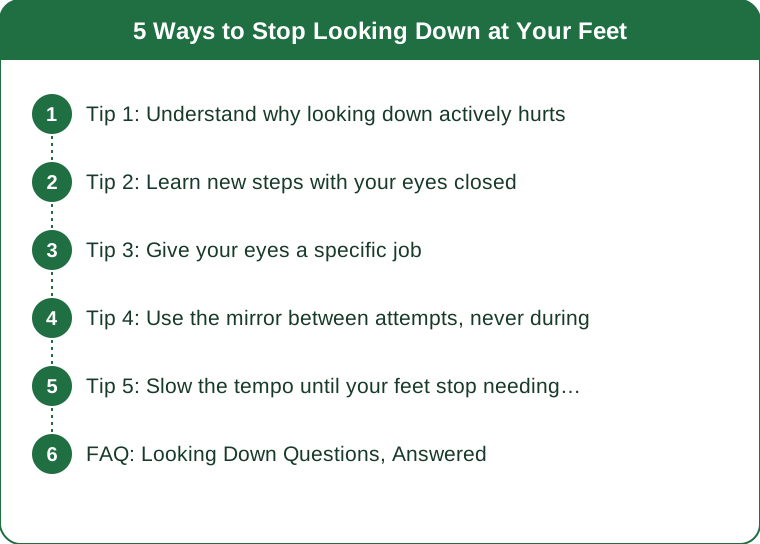
Tip 1: Understand why looking down actively hurts
Knowing the mechanism makes the habit much easier to break, because it stops feeling like a harmless comfort.
Your head is heavy - roughly five kilograms - and it sits at the top of a long lever. Dropping it forward shifts your centre of mass forward and down. In a dance built entirely around controlled weight transfer, that is a substantial disruption to every step you take.
It collapses the frame. The head drops, the upper back rounds, the chest closes, and the connection through your arms softens. Your partner immediately feels this as a loss of information, and in a lead-and-follow dance, lost information means a harder time for both people.
It removes spatial awareness. Looking down means you cannot see the floor around you, other couples, or the direction of travel - which matters enormously in a progressive dance moving around a room.
And it creates a feedback loop. Looking down makes your balance worse, worse balance makes you feel you need to check your feet, and the habit deepens.
The useful reframe: looking down does not tell you where your feet are. Your feet already know where they are - that information comes from your joints and skin, not your eyes.
Tip 2: Learn new steps with your eyes closed
The most direct intervention available, and it is uncomfortable for about two minutes and then genuinely enlightening.
How to do it: when you learn a new figure, walk through it slowly on your own with your eyes closed. No music, no partner, no mirror. Just the pattern, very slowly, feeling where your weight goes.
Why it works: it forces you to build the pattern using proprioception - your sense of where your body is in space - instead of vision. A step learned by feel does not need to be watched later. A step learned visually stays dependent on being watched.
Practical structure:
- Walk the figure four times slowly with eyes open, looking ahead
- Then four times with eyes closed
- Then four more with eyes open, ahead
The last set almost always feels more secure than the first, which is immediate proof the habit was not helping.
Safety note: clear the space first, and stay near a wall or a barre you can reach if you wobble. This is a solo drill, not something to attempt in a crowded class.
Tip 3: Give your eyes a specific job
Do not just tell yourself to stop looking down - that is an instruction to not do something, and those rarely work. Replace it with something to do.
Give your gaze a target:
- In closed hold, the standard position is looking over and slightly past your partner’s right shoulder, to the left of centre. Not at their face - past it.
- Practising alone, pick a spot on the wall at your own eye level and keep returning to it.
- Moving around the floor, look in the direction of travel, which also solves the collision problem.
Why the specific target matters: an eye position gives your head somewhere to be, and the head position sets the whole spine underneath it. Fix the eyes and the posture follows automatically, which is far easier than trying to correct the posture directly.
A drill that works well: put a small sticker or a piece of tape on the wall at your eye level. Dance a figure while keeping it in view the whole time. When you lose it, you know exactly when the habit kicked in - usually at the same difficult transition every time, which tells you which step actually needs work.
Tip 4: Use the mirror between attempts, never during
Mirrors are enormously useful and enormously easy to misuse, and this is one of the more common problems in a studio.
The trouble with dancing at the mirror: you are checking rather than feeling, and checking is exactly the visual dependence you are trying to break. Worse, watching yourself in a mirror while in hold twists your head and shoulders out of position, so you are simultaneously creating a fault and observing it.
The better protocol:
- Dance the figure with your eyes on your target, not the mirror
- Stop
- Then check the mirror, or better, watch a video back
- Adjust, and dance the next attempt with eyes forward again
Video is better than a mirror for exactly this reason - it lets you look at yourself without doing it while dancing. A phone propped on a chair for one run-through gives you more useful information than twenty minutes of glancing sideways.
When mirrors genuinely help: static posture checks, frame position, and arm shapes, all done standing still. Use them for still positions and video for moving ones, and the temptation to watch yourself while dancing largely disappears.
Tip 5: Slow the tempo until your feet stop needing supervision
The habit is strongest when you feel behind, so the honest fix is often to stop being behind.
Why speed drives the habit: when a figure comes faster than you can process it, you look down to confirm what your feet are doing, because you no longer trust that they know. That is a processing-speed problem presenting as a visual habit.
How to use tempo deliberately:
- Practise at roughly half speed with slow music or a metronome. At half speed there is time to feel each weight change.
- Increase in small increments - about 10 percent at a time - and drop back the moment your eyes go down. Your eyes are the honest signal that the tempo has outrun your competence.
- Return to full tempo only when you can hold your gaze forward throughout.
This also diagnoses the real problem. If you can hold your gaze at 80 percent tempo but not 100, the issue is not a bad habit - it is that the figure is not yet automatic. More slow repetitions will fix it; willpower will not.
Expect it to take a few weeks. Habits built over months of classes do not disappear in one session, and they reappear under pressure - at a social dance, with a new partner, or with a new figure. That is normal, and each time it happens it is telling you exactly which thing still needs slow practice.
FAQ: Looking Down Questions, Answered
Where exactly should I look in closed hold?
Over your partner’s right shoulder and slightly to the left, with the head turned gently and the chin level. Not down, not at their face, and not tipped back - a lifted chin looks strained and creates its own balance problem.
What if I genuinely do not know where my feet are?
That is a signal to slow down and repeat the figure at half tempo rather than to look. Foot position comes from repetition and feel, and looking at them during a step does not actually improve their placement.
Is it different for Latin and Standard?
The principle is identical, though the specific head positions differ - Latin has more varied head directions, including deliberate looks in the direction of movement. In neither is looking at the floor a correct position.
Will my partner notice if I stop looking down?
Almost immediately. Head position changes your balance and your frame, both of which a partner feels directly. This is one of the few changes that improves the experience for both people from the very first attempt.
How long does the habit take to break?
Most people see substantial improvement within three to four weeks of deliberate practice. It tends to return under pressure or with unfamiliar figures, which is a useful signal about what to practise rather than a sign of failure.
TL;DR:
- Looking down shifts your weight forward, collapses the frame, and removes information your partner needs
- Your feet already know where they are - that information comes from joints, not eyes
- Learn new figures with your eyes closed to build the pattern by feel
- Give your gaze a specific target rather than telling yourself not to look down
- Use mirrors for still positions and video for moving ones, never mirror-watching mid-figure
- Slow the tempo until your gaze stays forward, then rebuild speed by 10 percent at a time
The habit persists because looking down feels responsible, as though you are paying attention. You are - to the wrong thing. Give your eyes a job, slow the music down until they can keep it, and both your balance and your partner’s experience improve in the same week.
Keep Reading
This article is for general informational and styling purposes only. Fit, sizing, and product availability may vary.