5 Ways to Follow a Lead You Have Never Danced With
Quick Answer: The first eight bars with an unfamiliar partner are for gathering information, not for dancing well. Establish your own frame first and hold it consistently, calibrate to their pressure rather than matching your usual partner’s, wait a beat longer than feels comfortable before committing to a step, keep your weight fully on one foot at all times so you can be redirected, and let go of the choreography you know. Most awkward social dances are two people each waiting for the other to declare a standard - one of you has to be readable first.
You dance well with your regular partner and then a stranger asks you and everything falls apart. Nothing about your technique failed - you were reading a language you had not yet heard spoken.

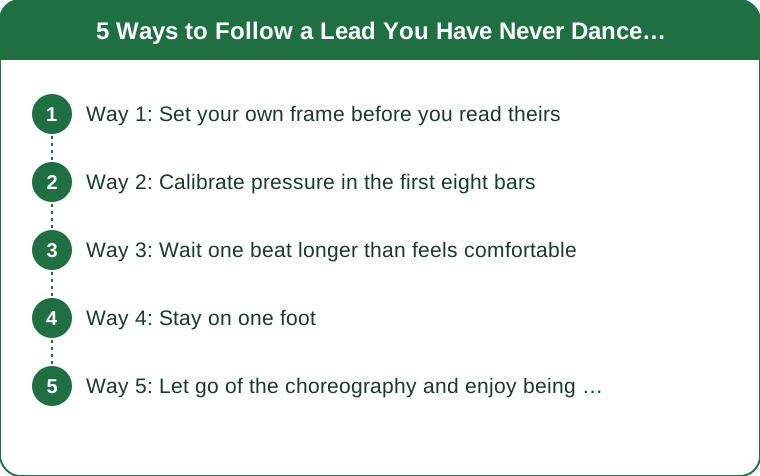
Way 1: Set your own frame before you read theirs
Your frame is your half of the connection and it is not negotiable. The most common mistake with an unfamiliar lead is adapting your frame to whatever they present - a soft frame, a heavy frame, an inconsistent one - which leaves neither person with a reference point.
Take your position deliberately in the first two bars. Elbows supported, shoulders down, back muscles engaged, hand contact firm but not gripping. Hold that consistently regardless of what arrives from the other side.
A consistent frame is a gift to a lead. It gives them something to move. A follower whose frame collapses on the first turn is genuinely difficult to lead well, no matter how skilled the lead is, and much of the awkwardness gets misattributed to the lead’s ability.
Resist matching a collapsing frame. If their frame is soft, keeping yours does not make you rigid or unfriendly - it gives the connection somewhere to live. Softening in sympathy leaves you both with nothing.
And check your own tension separately. Firm is not the same as stiff. Firm means the structure holds; stiff means the joints do not move. A useful self-check: can you breathe normally and turn your head? If not, you are stiff rather than framed.
Way 2: Calibrate pressure in the first eight bars
Every lead applies a different amount of pressure, and the amount you are used to is not the standard. Some lead almost entirely through body movement with very light hand contact; some are considerably more physical.
Use the first basic pattern purely to sample. Almost every lead opens with something simple. That is your calibration window - notice how much pressure precedes a movement, how early it arrives, and whether it comes through the hand, the frame, or the body.
Then match their scale, not their quality. If they lead lightly, respond to lighter cues. If they lead firmly, do not resist by becoming lighter in protest - you will read as unresponsive and they will push harder, which makes it worse for both of you.
There is a floor, though. A lead so heavy that it hurts, drags, or forces your body is not a calibration problem, it is a boundary problem. You are allowed to say something, adjust the hold, or end the dance. That is entirely normal social dance behavior and nobody worth dancing with will take offence.
Recalibrate through the dance. Leads often start cautiously with a new partner and become more definite once they trust the connection. The pressure at bar 8 is frequently not the pressure at bar 40.

Way 3: Wait one beat longer than feels comfortable
Anticipation is the single largest source of collision with a new partner. With a familiar lead you know what is coming and you move slightly early, which reads as responsive. With a stranger it reads as going somewhere they were not sending you.
Deliberately delay your commitment. Let the lead fully arrive before you step. This will feel late for the first minute and then feel correct, because it is correct.
The physical version of this is keeping your weight settled. Do not pre-shift toward where you think the step is going. Weight fully on the standing foot means you can be sent in any direction.
Expect to be a fraction behind the music at first. That is a reasonable trade for going the right direction. Musicality with a stranger comes after accuracy, not before.
And stop finishing patterns. If they lead the first half of a figure you recognize, resist completing it from memory. Plenty of leads use openings that go somewhere else, and a follower who completes the pattern they expected is now leading.
This is the hardest item on the list for experienced followers, precisely because knowing the vocabulary makes anticipation more tempting and more convincing.
Way 4: Stay on one foot
Split weight is the mechanical reason follows get stuck. If your weight is distributed between both feet, neither foot is free, and any lead that arrives has to overcome your inertia before it can move you.
Full weight transfer on every step. Settle completely onto the new foot, so the other foot is genuinely free and available. This is basic technique and it is the first thing to go under the stress of an unfamiliar partner.
The free foot should be genuinely free. Light, unweighted, able to move immediately in any direction. If you are bracing on it slightly for balance, you cannot be redirected.
This also solves the problem of unexpected redirects. A lead who changes their mind mid-figure - common in social dancing, especially in crowded rooms where floorcraft demands it - can only redirect a partner whose weight is committed and whose other foot is available.
Practise it alone. Walking around a room, stepping deliberately and fully onto each foot, pausing to confirm the other is genuinely free, is a five-minute drill that improves following with every partner.
And use your own balance, not theirs. Leaning on your partner for balance means every redirect destabilizes you both. Your frame connects you; your balance is yours.
Way 5: Let go of the choreography and enjoy being surprised
Social dancing is not performance and a new partner is not an audition. The measure of a good social dance is whether both people enjoyed it, not whether the figures were the ones you know best.
Expect a smaller vocabulary than you have. Most social dances with a stranger stay in the basics for the first minute or two while both people establish trust. That is the system working, not a disappointing partner.
Say something at the start. A single sentence - what you mostly dance, or that you are still learning a particular style - saves both of you a bar of guesswork. Social dancers do this constantly and it is entirely normal.
Smile and keep moving after a mistake. Every social dancer collides, misses, and steps on someone. The only real error is stopping to apologize at length in the middle of a busy floor. Acknowledge lightly and continue.
Notice what you learn. Dancing with many different leads is the fastest way to improve as a follow, precisely because it strips out the shared shortcuts you build with a regular partner. A dance that felt clumsy usually taught you more than a comfortable one.
And know that some pairings just do not click, for reasons of height, timing, style, or training background, and that is not a verdict on either dancer. Thank them, mean it, and ask someone else.
The underlying principle across all five: be readable and be available. A follower with a consistent frame, committed weight, and no anticipation is a pleasure to dance with even at a basic level - and that is a skill entirely within your control regardless of who asks you.
TL;DR:
- Set your own frame in the first two bars and hold it consistently, whatever arrives from the other side.
- Use the opening basic to calibrate their pressure, and match their scale - but a lead that hurts is a boundary issue, not a calibration one.
- Wait one beat longer than feels natural and never complete a pattern from memory.
- Keep full weight on one foot so the other is genuinely free and you can be redirected at any moment.
- Say one sentence at the start, expect a small vocabulary early, and treat a clumsy dance as the one that taught you most.
Following a stranger well is not about knowing more figures. It is about being consistent, patient, and available - and those three things work with every lead in the room.
Keep Reading
This article is for general informational and styling purposes only. Fit, sizing, and product availability may vary.