5 Signs Your Ballroom Dance Frame Is Actually Improving
Quick Answer: A genuinely improving ballroom frame shows up as less arm fatigue during longer dances, a partner reporting clearer lead-follow connection, and frame holding steady through turns — these practical signs matter more than how frame looks in a single practiced pose.
Frame is one of the hardest things to self-assess in ballroom dance, because it’s mostly felt by your partner, not seen by you. Here are 5 signs worth checking for.

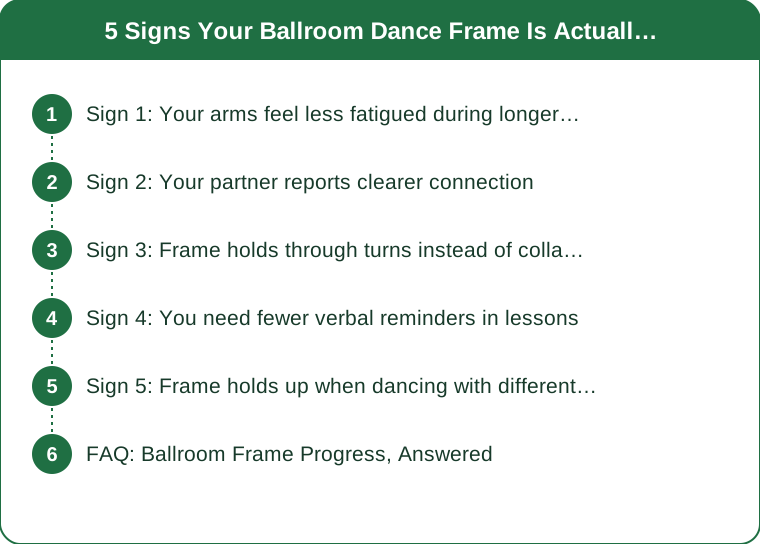
Sign 1: Your arms feel less fatigued during longer dances
A frame held mostly through shoulder and back tension fatigues fast. As core and back engagement improve and take over more of the work, arm fatigue during a full song noticeably decreases.
Sign 2: Your partner reports clearer connection
Frame quality is largely felt through connection, not seen. If your partner comments that leads or follows feel clearer or easier to read, that’s one of the most direct signs of real improvement.
Sign 3: Frame holds through turns instead of collapsing
Early on, frame often collapses briefly during turns as focus shifts to footwork. A frame that stays intact through turns reflects genuine postural strength, not just a static pose held while standing still.

Sign 4: You need fewer verbal reminders in lessons
If your instructor is correcting frame less often across the same combinations compared to a few weeks ago, that reduction itself is a concrete sign of retained improvement, not just a good day.
Sign 5: Frame holds up when dancing with different partners
A frame that only works with one familiar partner is often compensating for their specific habits. Frame that holds up reasonably well across different partners is a stronger sign of independently improved technique.
FAQ: Ballroom Frame Progress, Answered
How long does it typically take to build a strong ballroom frame?
Many dancers notice real improvement over 2-3 months of consistent practice, though frame continues refining for years at higher levels.
Should frame feel tense or relaxed when done correctly?
Firm but not tense — a correct frame uses core and back engagement, not gripped shoulder or arm tension, which is exactly why arm fatigue tends to decrease as frame improves.
Is it normal for frame to feel worse with a new partner?
Yes, some adjustment period is normal — but a frame that holds up reasonably well across partners, even with adjustment, indicates solid underlying technique.
TL;DR:
- Less arm fatigue over a full dance reflects frame supported by core and back, not tension
- A partner reporting clearer connection is one of the most direct improvement signs
- Frame holding through turns, not just static poses, shows real postural strength
- Frame holding up across different partners indicates independently improved technique
Frame progress is mostly felt, not seen — these signs make it easier to track.
Keep Reading
This article is for general informational and styling purposes only. Fit, sizing, and product availability may vary.