5 Practice Floor Problems That Are Not Actually Your Technique
Quick Answer: Practice problems that look like technique failures are often surface issues: too much grip stops your turns and strains knees, too little grip removes the resistance your balance depends on, and a carpeted room makes footwork feel impossible regardless of skill. Check the floor and the sole condition before rebuilding a technique that may be fine.
An evening where nothing works is demoralising, and the natural conclusion is that you’ve regressed. Before accepting that, it’s worth ruling out five things that have nothing to do with you.

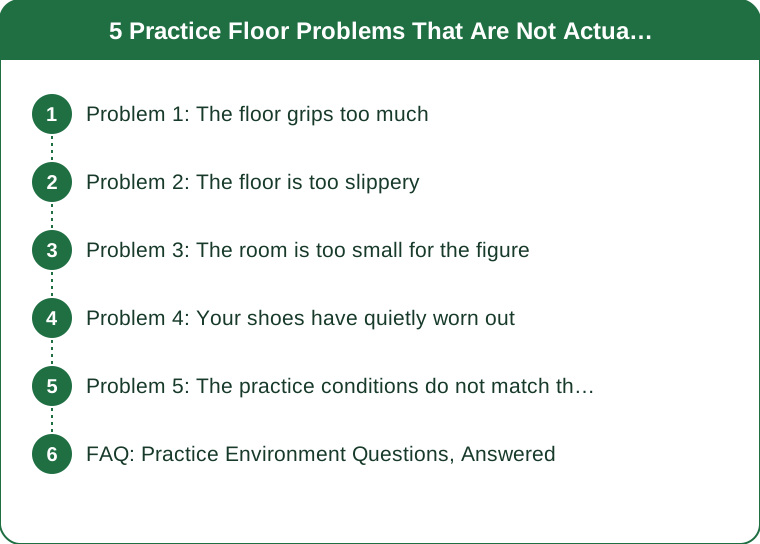
Problem 1: The floor grips too much
What it feels like: turns stop halfway, spins feel jerky, and you finish practice with sore knees or a tender inner knee.
What’s actually happening: a high-friction surface - most rubberised gym floors, some vinyl, and clean sealed concrete - prevents the pivot your body expects. When the foot can’t rotate, the rotation has to happen somewhere, and it happens at the knee.
This is the most genuinely risky item on the list. Knee rotation under load is a common mechanism for meniscal and ligament irritation, and it accumulates rather than announcing itself.
What to do:
- Suede-soled dance shoes are the standard answer, and they exist precisely for this reason
- On a grippy floor, a smooth leather sole or even a smooth-soled indoor shoe is safer than a rubber trainer
- Never practise turns in trainers on a rubber floor. Practise the parts that don’t rotate, and save turning work for a suitable surface
- A small portable dance floor panel - even 1m x 1m - is enough for pivot practice at home
The diagnostic: if turns feel fine in the studio and impossible at home, this is your answer, and no amount of technique work will fix it.
Problem 2: The floor is too slippery
What it feels like: no control, an inability to commit weight, and a constant sense of hedging. Balance feels worse than it was last month.
What’s actually happening: a polished or dusty floor gives you less resistance than your movement is calibrated for. Ballroom technique relies on pushing into the floor, and if the floor gives way, the push produces slide rather than travel.
Common culprits: newly polished wood, dusty church halls, and suede soles that have become glazed - which happens naturally with use.
What to do:
- Brush your suede soles. A wire shoe brush restores the nap, and glazed suede is by far the most common cause of sudden slipperiness. Brush before every practice - it takes ten seconds and most people do it monthly.
- Sweep the floor. Dust is the second most common cause and is almost always overlooked.
- On a genuinely over-polished floor, a lightly damp cloth over the surface adds temporary grip
- Avoid rosin unless the venue permits it - it’s effective and leaves residue that other users won’t thank you for
The tell that separates this from a technique issue: if you’re slipping on both feet equally and it started suddenly, it’s the floor or the soles. Technique problems are usually asymmetrical and gradual.
Problem 3: The room is too small for the figure
What it feels like: every progressive figure feels cramped, your partner and you keep adjusting, and long-line figures never feel right.
What’s actually happening: ballroom figures are built for floor travel. A living room forces shortened steps, and shortened steps change the timing, the rise and fall, and the swing - which means you’re practising a compressed version and then wondering why it doesn’t match in the studio.
What to do:
- Practise the elements that don’t travel: frame, foot placement, weight transfer, rise and fall in place, and rhythm. These are genuinely the highest-value things to drill and they need almost no space.
- Practise one step at a time, taking the full-size step and then resetting, rather than running the figure at reduced size
- Shadow practice - full-size steps without a partner, in the longest available line in your home, usually a hallway
- Do not drill full amalgamations at half size. Repeating a compressed version teaches the compressed version, and it takes real work to undo
A useful reframe: home practice is for quality of individual movements. Travel and amalgamations belong in the studio. Pairs who accept this split usually progress faster than those who try to do everything everywhere.

Problem 4: Your shoes have quietly worn out
What it feels like: balance issues that came on gradually, more ankle fatigue than usual, and a sense that your weight placement is off.
What’s actually happening: dance shoes break down in ways that aren’t visually obvious. The shank softens, the heel base compresses slightly out of true, and the suede glazes.
What to check, monthly:
- Heel tip wear. A worn tip changes the effective heel angle and therefore your entire weight placement. Tips are cheap and replaceable - this is the most commonly ignored maintenance item in ballroom.
- Sole flexibility. If the shoe folds much more easily than it did new, the shank has gone and the support with it.
- Suede nap. Brush it; if brushing doesn’t restore grip, the suede is worn through.
- Fit. Dance shoes stretch with use, and a shoe that has loosened by even a small amount changes how you grip the floor with your foot.
Realistic lifespan: for a few hours of practice a week, roughly 9 to 18 months for practice shoes. Competition shoes used regularly wear faster than people expect.
The false conclusion this causes: people conclude their balance is deteriorating, when their shoes are. Replacing worn shoes frequently produces an immediate, surprising improvement.
Problem 5: The practice conditions do not match the event
What it feels like: you’re fine in practice and lost at a social or a competition.
What’s actually happening: you’ve trained in one set of conditions and are performing in another. The variables that change most:
- Floor type - a sprung competition floor behaves very differently from a hall floor, and it changes rise and fall noticeably
- Crowding - social floors have other couples, which shortens every figure and requires floorcraft you can’t practise alone
- Lighting - dim social lighting removes the visual references you unconsciously use for balance
- Shoes - practising in one pair and competing in another, particularly at a different heel height, is a genuine change
- Temperature and clothing - a competition dress or a warm room changes movement more than people expect
What to do:
- Practise in your event shoes at least once a week in the month before
- Practise with lights lowered occasionally - it’s a surprisingly effective way to expose over-reliance on visual balance
- Attend socials regularly rather than only practising - floorcraft is only trainable in traffic
- Run through a full routine without stopping, at least once per session, because stopping to correct is a practice habit that doesn’t transfer
The general principle: if the gap between practice and performance is large, close the gap by changing the practice, not by adding more of it.
FAQ: Practice Environment Questions, Answered
Can I practise on carpet at all?
For frame, arm work, timing, and weight transfer, yes. For anything involving a turn or a slide, no - carpet grip is high enough to strain the knee, and the footwork you’d be learning wouldn’t transfer.
Are portable dance floor panels worth it?
For anyone practising at home regularly, a small panel - even one metre square - makes pivot and spin practice possible and safe. It’s one of the better value purchases in the hobby.
How often should I brush my suede soles?
Before every practice. It takes ten seconds and it’s the single most common overlooked maintenance item. If the suede looks shiny, it’s already overdue.
My knees hurt after practice at home. Is that normal?
No - and a grippy floor is the first thing to rule out. Knee pain from rotation on a high-friction surface is common and preventable. If it persists after changing surface and shoes, see a physiotherapist rather than working through it.
TL;DR:
- Too much grip stops turns and rotates the knee instead - never practise turns in trainers on rubber
- Sudden slipping is usually glazed suede; brush the soles before every practice
- Small rooms are for frame, weight transfer, and rise and fall - not for compressed amalgamations
- Worn heel tips and softened shanks masquerade as deteriorating balance
- Close the practice-to-event gap by changing the conditions, not by adding hours
Before rebuilding a technique that may be perfectly sound, spend ten minutes on the floor, the soles, and the room. It’s a cheaper diagnosis and it’s right more often than you’d think.
Keep Reading
This article is for general informational and styling purposes only. Fit, sizing, and product availability may vary.