5 Floorcraft Rules That Make You a Dancer People Want to Partner
Quick Answer: Floorcraft is the ability to navigate a crowded floor without collisions, and it matters more to your reputation as a social dancer than your technique does. The five rules: know the line of dance, keep your eyes up and scan ahead, have a small-space repertoire, adjust your amplitude to the crowd, and take responsibility for the collision regardless of fault. All five are learnable in a few socials.
A technically excellent dancer who bumps into people is a worse partner than a technically modest one who never does. That trade-off surprises people, and it’s consistent across every social floor.

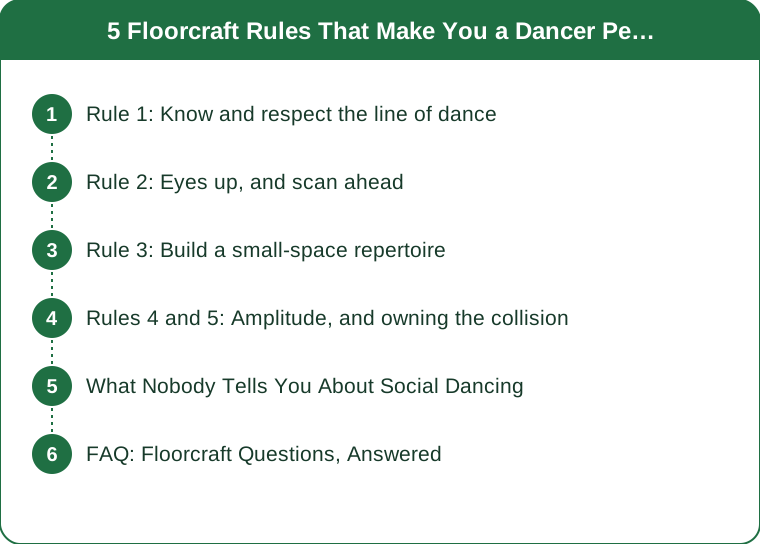
Rule 1: Know and respect the line of dance
The single most important convention on a ballroom floor, and the one beginners most often break without knowing it exists.
The line of dance runs anticlockwise around the floor. Progressive dances - waltz, foxtrot, quickstep, tango, Viennese waltz - travel along it. Everyone moves in the same direction, like traffic.
The lane structure:
- The outside lane is for the fastest-moving couples with the biggest steps
- The middle lane is for moderate movement
- The centre of the floor is for stationary or slow dances, and for practising figures that don’t travel
The rules that follow:
- Never dance against the line of dance. Reversing into oncoming traffic is the most disruptive thing you can do on a social floor
- Don’t stop in the outside lane. If you need to pause, step toward the centre
- If you’re slower, move inward. Blocking the fast lane creates a pile-up behind you
- Non-progressive dances stay in the centre. Rumba, cha cha, and swing shouldn’t be occupying the travelling lanes
How to learn it fast: stand at the edge for one song and just watch the traffic. The pattern becomes obvious in ninety seconds, and it’s the highest-return ninety seconds available to a new social dancer.
Rule 2: Eyes up, and scan ahead
The follow’s role in floorcraft is systematically undertaught, and it’s substantial.
For the leader: you’re driving forward and you can see where you’re going. Look over your partner’s shoulder and scan the space ahead, not down at your feet or at your partner’s face. The couple ahead of you is your speed limit.
For the follower: you’re often travelling backward with no view of where you’re going, and you can see everything behind the leader that they can’t. In many partnerships the follower is the one who spots the developing collision.
- Some couples use a light squeeze or a subtle resistance as a signal
- Many simply say “couple behind” quietly, which is entirely acceptable at a social
- Being a good follower here doesn’t mean silently accepting a collision. That’s a misreading of the role that leads to bruised heels
The scanning habit: look three to four couples ahead, not at the couple immediately in front. By the time the nearest couple is a problem, you’ve run out of options.
Head position matters technically too - looking down changes your posture and your balance in every ballroom style, so the floorcraft habit and the technique habit reinforce each other.
Rule 3: Build a small-space repertoire
The difference between a dancer who copes with a crowd and one who doesn’t is usually five figures.
When the floor is packed, your big progressive figures won’t fit. If your entire vocabulary travels, you’ll either stop dancing or collide.
Have these ready in every dance you do:
- A figure that turns in place - a rotational figure that takes no floor space
- A figure that moves sideways - so you can change lanes without stopping
- A figure you can shorten - the same step with a smaller stride
- A simple hold-and-sway - somewhere to park for two bars while a gap opens
- A way to reverse direction gracefully if you’re boxed in
In waltz: a spin turn in place, a hesitation, and a whisk are the classic small-space tools.
In foxtrot: rock turns and reduced-stride basics.
The practice that builds it: in class or practice time, dance an entire song within a two-metre square. It feels absurd and it’s the single best floorcraft drill there is. You’ll discover in three minutes exactly how much of your repertoire depends on space.
A crowded floor is a skill test, not an obstacle. Dancers who can shrink their dancing to fit are the ones who never look flustered.

Rules 4 and 5: Amplitude, and owning the collision
Rule 4: Match your amplitude to the room
The size of your steps and the extent of your arm and body movement should scale with the space available.
- Empty floor: full stride, full extension, use everything
- Moderately busy: reduce stride by roughly a third, keep arms within your own footprint
- Packed: small steps, minimal extension, rotation over travel
The most common floorcraft failure at socials is a dancer executing a full-amplitude routine learned in an empty studio, on a floor with sixty people on it. It reads as inconsiderate even when it isn’t meant that way.
Arm styling in particular: a fully extended arm at shoulder height is a hazard in a crowd. Bring it in. Nobody is watching your arm styling as closely as you’d hope, and everyone notices being hit by it.
Rule 5: Apologise first, regardless of fault
This is a social convention rather than a technical one, and it does more for your standing on a floor than any figure you can learn.
When a collision happens:
- Acknowledge it immediately with a smile and a brief apology, whoever caused it
- Don’t stop to discuss it. Keep dancing; a five-second apology is complete
- Never assign blame on the floor. It’s a social evening, not an investigation
- If you clearly caused it, say so clearly - and then adjust your dancing rather than repeating it
Conventionally, the leader carries more responsibility for navigation, but the apology isn’t about fault. It’s about the floor remaining a pleasant place to be, which is the entire point of a social.
One genuine safety note: heels and toes get injured on crowded floors. If someone is hurt, stop and check. That’s the exception to keep-dancing.
What Nobody Tells You About Social Dancing
Floorcraft outranks technique in how partners choose you. People remember whether dancing with you was comfortable and safe far more clearly than they remember your footwork. This is the most useful thing a new social dancer can know.
Class dancing and social dancing are different skills. Class happens in lines, with space, with everyone doing the same figure. A social floor has sixty people doing different things at different speeds. Being excellent in class predicts less about social dancing than people expect.
The best social dancers make their partner look good, which mostly means dancing at the level their partner can follow rather than at the level they can lead. A confused partner is a floorcraft hazard too.
Ask, don’t assume, about hold and closeness. Preferences vary and a brief check at the start of a dance is normal and appreciated.
You are allowed to decline a dance, and you don’t owe a reason. “Not this one, thank you” is complete. Equally, accept a decline gracefully - it’s rarely about you.
Volume of dancing beats intensity of practice for floorcraft specifically. It’s a situational skill that only develops in situations, so going to socials is the training.
Watch the experienced couples for one song each evening. Not their figures - their navigation. Where they look, when they change lanes, how they handle being boxed in. It’s the fastest way to learn a skill nobody explicitly teaches.
FAQ: Floorcraft Questions, Answered
What if I’m the one being crowded constantly?
Move inward a lane and slow down. It’s not a defeat - the centre lanes are legitimate dancing space and are considerably more relaxed.
Should followers speak up about hazards?
Yes. A quiet word is standard practice at socials and is far better than a collision. It isn’t a breach of the partnership.
How do I handle a leader who won’t navigate?
Shorten your own steps and be ready to check backward movement. If it’s genuinely unsafe, end the dance politely at the end of the song and don’t accept the next one.
Is floorcraft different in Latin dances?
The line of dance matters less because most Latin dances are non-progressive, but spatial awareness matters just as much - arms and spins take room. The centre-of-floor convention exists for exactly this reason.
TL;DR:
- Line of dance runs anticlockwise; fast dancers outside, slow inward, non-progressive in the centre
- Eyes up, scan three or four couples ahead; followers should call out what leaders can’t see
- Keep five small-space figures ready and practise a whole song in a two-metre square
- Scale your stride and arm styling to the crowd, not to the studio you learned in
- Apologise first regardless of fault, and keep dancing
Nobody at a social remembers your heel turn. They remember whether dancing near you was safe, and that’s a skill you can learn in three evenings.
Keep Reading
This article is for general informational and styling purposes only. Fit, sizing, and product availability may vary.