5 Ballroom Drills That Fit in a Small Apartment (No Partner, No Studio)
Quick Answer: The things that improve fastest without a partner are the things that don’t need one: foot pressure and rise-and-fall, frame endurance, standing turns, rhythm precision, and the sway that makes standard styles look finished. All five fit in about two metres square. Choreography and lead-follow do not, and trying to practise those alone is where most home practice quietly wastes its time.
You don’t need a studio to improve. You need to know which half of ballroom is portable - and it’s a bigger half than most people assume.

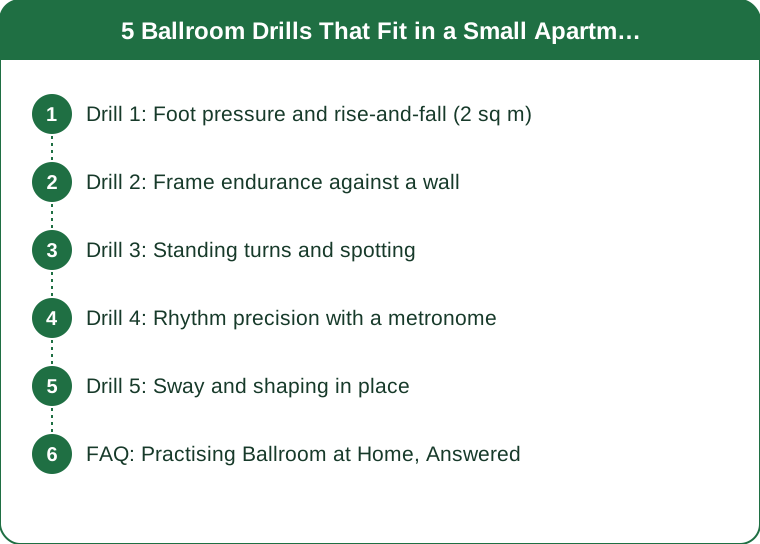
Drill 1: Foot pressure and rise-and-fall (2 sq m)
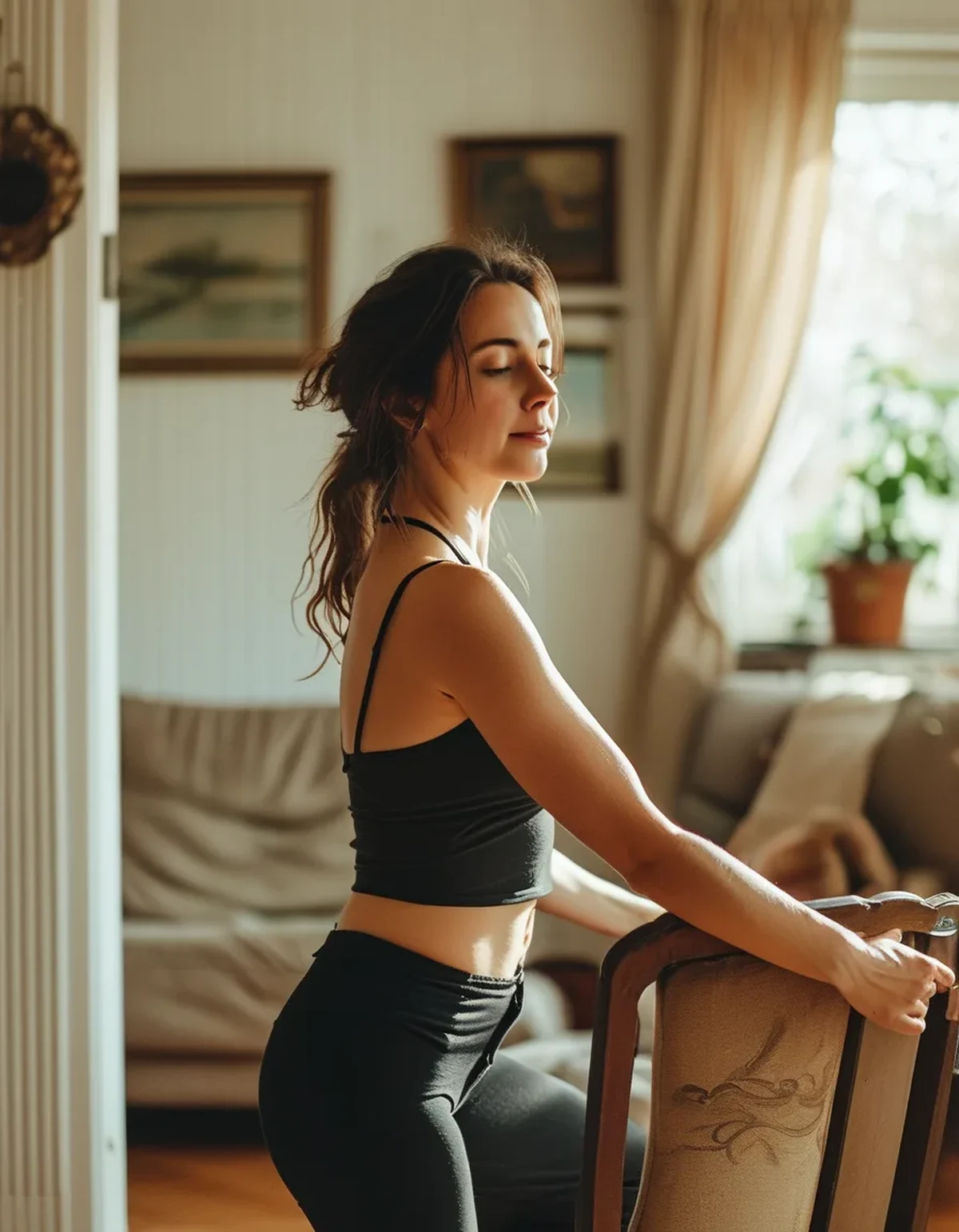
What to do: Stand with feet together, hands lightly on a chair back. Roll slowly from heel through the whole foot to the ball, rise onto the toes, then lower back through the same path over four slow counts each way. Then do it in a small forward step: heel first, roll through, rise, lower.
Why it’s first: rise-and-fall is what makes waltz look like waltz, and it lives entirely in your feet and ankles. It’s also the single most common thing that separates a technically correct social dancer from one who looks like they’ve had lessons - and it requires literally no space and no partner.
The detail that matters: the rise should come from the ankle and leg extending, not from lifting your shoulders. Put your free hand on your own shoulder while you rise; if it moves upward before your heel does, you’re lifting rather than rising.
Reps: 3 sets of 8 slow rises, then 3 sets of 8 in a walking step. Four minutes total.
How you’ll know it’s working: your calves will be tired, which surprises people, and your first waltz at the next social will feel noticeably smoother through the ones.
Drill 2: Frame endurance against a wall
What to do: Stand with your back a few centimetres from a wall, arms up in your frame position. Hold. Set a timer. The wall is a reference, not a support - you shouldn’t be touching it, and if you drift back into it, your posture is collapsing.
Why it works alone: frame is a strength and endurance problem disguised as a technique problem. Most frames don’t collapse because the dancer doesn’t know where the arms go - they collapse in the third minute because the upper back gets tired. Nobody fixes that in class, because class doesn’t hold the frame still long enough to expose it.
The progression: start with 3 holds of 45 seconds. Build to 3 holds of 90 seconds over about a month. Then add slow head turns to the left while holding, which is where standard frames actually have to work.
What to feel: the effort should sit between the shoulder blades and along the sides of the ribs, not in the top of the shoulders or the neck. If your neck is doing it, lower the arms slightly and rebuild from there.
Two minutes, three times a week, and the difference at a social is obvious by week three - specifically in the last dance of the night rather than the first.
Drill 3: Standing turns and spotting
What to do: Mark a spot on the wall at eye height. Do slow standing turns in place - quarter turns first, then halves, then full - keeping your eyes on the spot as long as possible and whipping your head around last.
Why it’s a home drill: turns need one square metre and no partner, and dizziness is a trainable adaptation rather than a fixed trait. Practising turns at home is the only realistic way to accumulate enough repetitions to adapt, because a class gives you maybe a dozen.
The technical points: stay over the ball of the standing foot, keep the free leg’s foot in contact with the standing ankle, and initiate the turn from the floor rather than from the shoulders. Turning from the upper body is the reason turns feel out of control.
Reps: 8 quarter turns each direction, 8 halves, then as many full turns as you can do cleanly - typically 4-6 at first. Stop when quality drops rather than when you feel dizzy.
A word on floors: carpet makes pivots nearly impossible and can strain a knee. A hard floor in socks, a small piece of lino, or a dance mat is worth the effort if you’re doing this regularly.
Drill 4: Rhythm precision with a metronome
What to do: Set a metronome or a phone app. Waltz around 84-90 bpm in 3/4, tango around 120-132, cha-cha around 120-128. Step your basic in place, one foot to the other, and land exactly on the beat. Then deliberately practise landing slightly ahead and slightly behind so you can feel the difference.
Why it’s undervalued: rhythm errors are the most common thing that makes a social dance feel like hard work for both people, and they’re almost invisible to the person making them. A partner absorbs your timing errors and neither of you knows it’s happening. A metronome doesn’t.
The advanced version: step the basic while counting aloud, then while counting the off-beats, then in silence with the metronome sounding only every other bar. That last one exposes whether you actually have internal timing or whether you’ve been following the click.
Five minutes, and it’s the drill most likely to change how partners describe dancing with you.
Do it with music too, not just the metronome. A metronome trains precision; music trains phrasing, and social dancing needs both.
Drill 5: Sway and shaping in place
What to do: Feet apart in a small side step, weight on one foot. Create a gentle side stretch through the ribs - lengthening the top side rather than collapsing the bottom one - and hold for four counts. Alternate sides. Then add it to a slow side step.
Why it’s the finishing detail: sway is what makes standard styles look like they’re moving through the music rather than executing steps. It’s also the thing most social dancers never work on, because it’s invisible in a beginner class and only starts mattering once your steps are solid.
The common error: tipping the head and shoulders sideways instead of stretching through the ribcage. Practise in front of a mirror or with a phone camera - the correct version looks like a long curve from the standing foot to the top of the head, not a lean.
Reps: 8 slow holds each side, then 8 in a side step, three times a week.
Putting the five together: the whole set is about 20 minutes. Do it three times a week and the realistic expectation is that frame endurance and rise-and-fall show up at a social within three weeks, turns within about six, and sway - which is the subtlest - somewhere around eight to ten. That’s a faster return than most people get from an extra class a month, and it costs nothing but floor space you already have.
FAQ: Practising Ballroom at Home, Answered
What can’t I practise without a partner?
Lead and follow, connection, floorcraft, and anything requiring a second body’s weight and momentum. Practising these alone builds habits you then have to unlearn, so it’s genuinely better to skip them.
Do I need dance shoes at home?
Socks on a hard floor work for most of this and are kinder to the floor. Use your actual dance shoes occasionally, since heel height changes your balance point noticeably.
How much space do I really need?
About two metres square covers all five drills. Turns need the most; frame work and rise-and-fall need almost nothing.
Is it worth practising if I only go to one class a week?
That’s exactly when it’s most worth it. One class a week is barely enough repetition to retain anything, and 20 minutes of home practice roughly doubles your contact time with the material.
TL;DR:
- Five drills, two square metres, about 20 minutes: rise-and-fall, frame endurance, turns, rhythm, sway
- Frame collapses from fatigue, not ignorance - hold it 90 seconds and find out
- Turns need repetition volume that class can’t provide
- A metronome catches timing errors that a partner silently absorbs
- Skip lead-follow practice alone; it builds habits you’ll have to unlearn
Half of ballroom is portable. Practise that half and let class handle the rest.
Keep Reading
This article is for general informational and styling purposes only. Fit, sizing, and product availability may vary.