No Partner, No Problem: Ballroom Practice That Works in Your Living Room
Quick Answer: Roughly 80 percent of what makes a good ballroom dancer - timing, balance, weight transfer, footwork patterns, frame tone, and styling - trains completely alone, and the dancers who improve fastest between lessons are the ones drilling it. The working formula: a 6-by-6-foot floor patch, smooth-soled shoes or socks, music at practice tempo, a propped phone for feedback, and a 20-minute structure of basics, isolated technique, and timing work, two or three times a week.
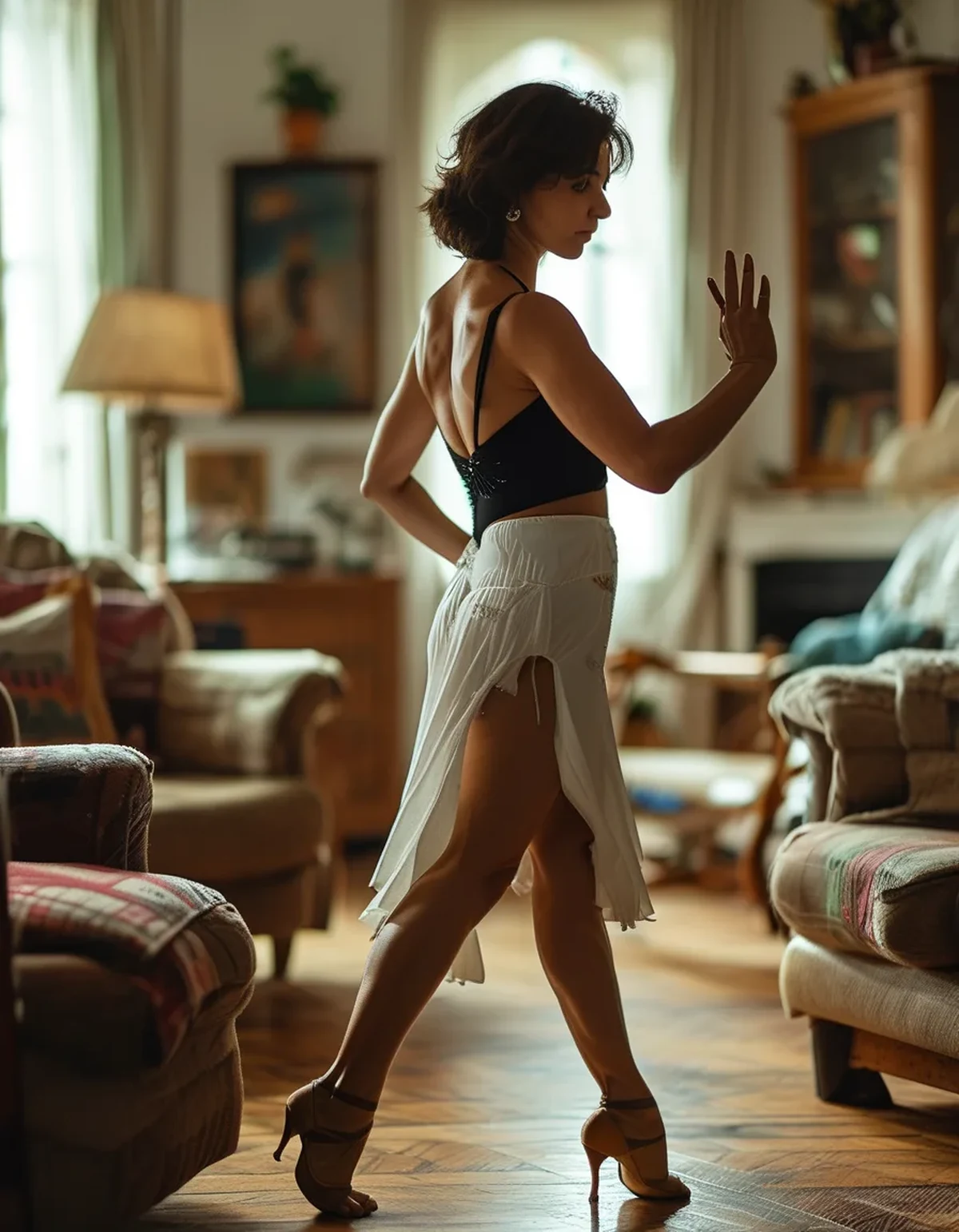
Everyone waits for a partner to practice - and meanwhile the best partner dancers you know built their dancing alone in kitchens. Connection is the last 20 percent of ballroom. The first 80 is what your own body does, and your living room is fully equipped to train it.
What can solo practice actually build - and what genuinely needs a partner?
Sorting this honestly is what turns home practice from consolation prize into the main engine.
Fully trainable alone:
- Timing and musicality - hearing the beat, subdividing it, landing steps on it. This is the number-one separator at social dances, and it is 100 percent solo work.
- Weight transfer and balance - arriving fully over each foot before the next step. The single most partner-relevant skill there is, trained best without one, because a partner masks incomplete transfers.
- Footwork patterns - the figures themselves, heel-toe mechanics, foot turnout, ankle articulation.
- Frame tone and posture - holding your own arms and back with consistent, self-supported shape.
- Styling - hip action in Latin, rise and fall in smooth styles, head and arm lines.
Partially trainable alone: leading and following mechanics (you can pattern your own side - where your weight and frame should be at each moment - which is most of it), and rotation in turns (spotting and balance train solo; shared-axis turns need the other person).
Genuinely needs a partner: the connection itself - reading and transmitting through physical contact, matching another body’s momentum. This is real and irreplaceable, and it is also the part your lessons and socials already provide.
The economics follow directly: paying for lessons while never drilling solo means spending lesson time on things a kitchen could have taught you - and every hour of home basics converts partner time into practicing the only thing partner time can teach.
How do you set up a practice space that actually gets used?
The barrier to home practice is never space - it is friction. Engineer both:
The floor: a 6-by-6-foot patch is enough for basics in place, and a hallway adds travel for walks. The surface matters more than the size: smooth hard flooring (wood, laminate, tile) lets feet slide and pivot as ballroom requires. On carpet, pivots torque the knees - do not force them; train in socks and convert traveling figures to in-place versions, or invest in a small smooth practice board or square of hardboard for turn drills.
The feet: smooth-soled shoes or socks, never sneakers. Rubber grip is the enemy of every pivot and the friend of every twisted knee. Actual dance shoes if you own them (practicing in your heels is its own skill-builder - more below), leather-soled flats or socks if not.
The feedback: a phone propped at chest height, filming most sessions. Ballroom is a visual discipline being practiced without the studio mirror - the camera is the mirror, and thirty seconds of playback teaches what an hour of feel cannot. This is the piece most home dancers skip and the one instructors most wish they would not.
The music: playlists at practice tempo, prepared in advance. Slower than performance tempo for new material - strict-tempo ballroom practice tracks exist for every dance, or use a tempo-adjust app on songs you love. Deciding music mid-session is how ten minutes evaporates.
The friction-killers: shoes, phone stand, and playlist live together in one visible spot; furniture that must move has a known 60-second configuration. A practice that takes four minutes to begin happens weekly; one that takes forty seconds happens daily.
What does the 20-minute session structure look like?
Three blocks, repeatable for any dance you are learning:
Block 1 - basics on the beat (7 minutes). Your current dance’s basic figure, on time, full weight transfers, dozens of repetitions. Box steps, rumba basics, jive triple-steps - whatever the lesson material is. Start at reduced tempo until footwork is automatic, then real tempo. The discipline: every step lands on its beat and every transfer completes - quality reps, not choreography tourism. This block alone, done consistently, transforms social dancing.
Block 2 - one isolated technique (7 minutes). Pick a single element per session and drill it stripped of everything else:
- Rumba walks down the hallway - slow, hip action from the weight change, arriving over a straight leg
- Rise and fall for waltz - ankles and knees breathing through the count, drilled on the spot
- Spotting practice for turns - eyes snapping to one point through slow rotations
- Cuban motion in place, hands on hips, watching the phone playback
- Frame holds - practice position, 60 seconds of toned-not-tense, filmed and checked
Rotate through your weak list; one element per session, returning weekly.
Block 3 - timing and flow (6 minutes). Music on, dance the material continuously - basics plus whatever figures you know, linked, imperfect, moving. Half the block at your level; the last songs purely for joy, because the practice that ends pleasantly is the practice that happens again Thursday.
Frequency beats duration: two or three of these 20-minute sessions weekly outbuilds one heroic weekend hour - motor patterns consolidate between sessions, not during them.

5 Mistakes Everyone Makes Practicing Alone
Mistake 1: Practicing figures, skipping technique. Running through step patterns feels like progress; drilling weight transfer feels like nothing. But patterns with poor transfers are choreography you cannot actually dance with a partner - and the dancers who plateau for years are almost always pattern-collectors. Block 2 exists because of this mistake.
Mistake 2: Dancing to whatever is playing. Random music means random tempos, and half the value of solo work is metronomic timing discipline. Strict-tempo or tempo-checked playlists are the difference between practicing timing and rehearsing approximation.
Mistake 3: Never filming. Feel lies generously - the hip action that feels enormous barely registers on camera, the frame that feels strong has drooped by minute two. Thirty seconds of playback per session recalibrates everything. It is uncomfortable for exactly two weeks, then becomes the tool you cannot practice without.
Mistake 4: Practicing only the favorite dance. The cha-cha you love gets four sessions; the waltz you need gets none. Rotate deliberately - the weak dance gets the first block of the week, when discipline is highest.
Mistake 5: Ghosting an imaginary partner too early. Waving arms around empty space rehearses vagueness. Until the footwork is automatic, practice in practice frame - arms held in position, self-supported, learning your own side completely. The partner-shaped hole in the air fills correctly at the studio; the fourth mistake wastes sessions, but this one actively builds habits your teacher then has to un-teach. Your own balance, your own timing, your own frame: that is the homework. The connection is the classroom.
How do you keep solo practice feeding your partner dancing?
The loop that makes home work pay off at the studio and the social floor:
Bring lesson notes home within 48 hours. Whatever the instructor corrected this week becomes Block 2 for the next three sessions - technique corrections decay in days if undrilled, and instructors repeat un-practiced corrections for months. A one-line note after each lesson (left transfer incomplete in natural turn) is the entire system.
Bring home questions back to lessons. Filming yourself generates precise questions - is my rise happening on the right count? - and precise questions get precise answers. This is how lesson value compounds: the teacher stops diagnosing from scratch and starts refining.
Practice in your dance shoes weekly. Heels change balance, pivot mechanics, and rise-and-fall entirely; the body that has only drilled in socks meets its shoes as a stranger at every social. One session per week in shoes keeps the calibration current - and doubles as the heel-endurance training long dance evenings demand.
Use the wall and the doorframe as honest partners. A wall in front of you polices toppling-forward walks; fingertips on a doorframe during balance endings reveal exactly how much support you were borrowing. Neither lies, neither leads, both available at midnight.
And schedule the payoff. A social dance or group class every few weeks converts home equity into partnered skill - and supplies the motivation loop. Solo practice without occasional partnered proof drifts toward abandonment; the calendar entry is part of the training plan.
Six weeks of this loop - two or three home sessions, one lesson, notes traveling both directions - typically outpaces six months of lessons-only. The partner was never the prerequisite. The floor patch was.
FAQ: Solo Ballroom Practice Questions, Answered
Can I actually learn ballroom from zero at home, or only maintain?
You can build a genuine foundation - timing, balance, basic figures, posture - from good instructional videos, and it will put you far ahead of the average beginner at your first classes. What home cannot teach from zero is connection, and self-taught patterns benefit from an instructor’s early eye before habits set. The ideal zero-budget path: video-led home work plus an occasional group class as calibration.
How do I practice turns without getting dizzy or falling?
Spotting is the answer and it trains solo: pick an eye-level point, rotate slowly keeping eyes on it until the last moment, snap the head around to re-find it. Drill quarter turns, then halves, then fulls, near a wall at first. Dizziness fades within a couple of weeks of daily 2-minute spotting practice - it is a trainable reflex, not a fixed trait.
Is it worth buying a practice partner frame or dance stand?
Generally no - the gadget teaches leaning on something, which is the exact habit partner dancing punishes. Practice frame (self-supported arms), the wall, and the doorframe drill cover the same ground free and teach self-carriage, which is what a real partner wants from you anyway.
My floor plan only fits basics in place - is that enough?
Mostly yes: in-place basics, technique isolations, timing work, and styling are the highest-value blocks anyway, and a hallway covers walks. The figures that genuinely need travel distance - long waltz sequences, tango walks across a room - get their reps at the studio. No competitive dancer’s kitchen fits a full long wall either; they drill exactly what you can.
TL;DR:
- 80 percent of ballroom - timing, weight transfer, footwork, frame, styling - trains fully alone; only connection needs a partner
- Setup: a 6-by-6 smooth floor patch, smooth soles or socks (never sneakers, never forced pivots on carpet), practice-tempo playlists, and a propped phone
- The 20-minute structure: basics on the beat, one isolated technique, then continuous flow - two or three times weekly
- Film sessions, drill lesson corrections within 48 hours, practice in your dance shoes weekly, and skip the imaginary-partner arm-waving
- A social or class every few weeks converts home equity into partnered skill and keeps the loop alive
Waiting for a partner to practice is how ballroom stays a lesson-day hobby. The dancers whose timing never wavers and whose balance never borrows built both in ordinary rooms between lessons - and the studio is where they went to spend it.
Keep Reading
This article is for general informational and styling purposes only. Fit, sizing, and product availability may vary.