Why Your Ballroom Frame Keeps Collapsing — and the Drill That Actually Fixes It
Quick Answer: A collapsing frame is usually caused by holding tension in the shoulders instead of the back and core, which fatigues fast and folds under any lead pressure. Practicing frame with your hands on a wall (not a partner) isolates the correct muscles before adding movement.
Your instructor keeps saying the same thing: ‘hold your frame.’ You try, and it holds for exactly one turn before folding. That’s not a listening problem — it’s the wrong muscles doing the holding.

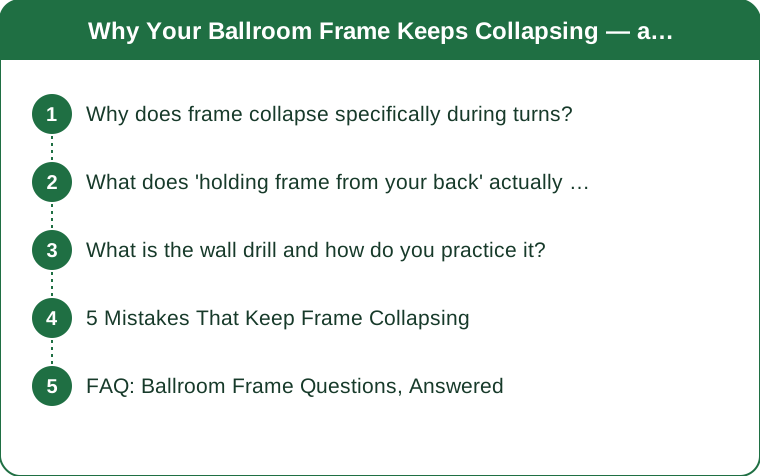
Why does frame collapse specifically during turns?
Most beginners hold frame tension in the shoulders and arms, which are small, fast-fatiguing muscle groups. The moment a partner applies any leading pressure — especially through a turn, where rotational force adds to the challenge — shoulder tension gives out and the frame folds inward.
A stable frame actually comes from the back muscles (lats, rhomboids) and core, which are larger, more fatigue-resistant, and built to hold sustained tension through rotation without collapsing.
What does ‘holding frame from your back’ actually feel like?
It feels like a slight, sustained engagement between your shoulder blades, as if gently squeezing a pencil between them, combined with a lifted, engaged rib cage — not raised shoulders, not locked arms.
Most dancers can feel the difference immediately with one test: raise your arms into frame position, actively shrug your shoulders up toward your ears (that’s the shoulder-tension version), then drop shoulders down and back while keeping arm height the same (that’s the back-engaged version). The second version holds far longer without fatigue.

What is the wall drill and how do you practice it?
Stand facing a wall, arms up in frame position with palms flat against the wall at shoulder height. Press gently into the wall while keeping your shoulders down and back — this trains the back-engagement pattern without a partner’s variable pressure to react to.
Hold for 20-30 seconds, 5-8 repetitions, focusing purely on which muscles are doing the holding. Once the back-engaged feeling is consistent and easy to find, reintroduce it with a partner, starting with simple steps before adding turns.
5 Mistakes That Keep Frame Collapsing
1. Raising shoulders toward the ears under any pressure — the single most common collapse trigger.
2. Locking elbows rigidly instead of maintaining a soft, sustained curve — rigid joints transmit shock instead of absorbing it.
3. Holding breath during turns. Held breath tightens the wrong muscles and cuts off the core engagement that should be stabilizing frame.
4. Only practicing frame with a partner. Partner pressure varies and is harder to isolate the correct muscle feel from — solo wall practice removes that variable.
5. Trying to ‘fix it’ by gripping harder. More grip tension in the hands doesn’t stabilize frame — it’s a back and core job, not a hand job.
FAQ: Ballroom Frame Questions, Answered
How long does it typically take to build a stable frame?
Most dancers notice a meaningful difference within 2-3 weeks of dedicated wall-drill practice, though full consistency under a partner’s varying lead often takes a full season of regular practice.
Should frame feel tiring during a dance?
A well-engaged back-based frame should feel like sustained, mild effort, not exhausting tension — if your shoulders burn after one song, you’re likely still holding from the wrong muscles.
Does frame matter more in some dance styles than others?
Standard ballroom styles (waltz, foxtrot, tango) rely on frame heavily for connection; Latin styles use a related but slightly different frame concept adapted to faster, looser movement.
TL;DR:
- Collapsing frame usually comes from shoulder tension, not back/core engagement
- Back-engaged frame feels like a gentle squeeze between shoulder blades, shoulders down
- The wall drill (20-30 sec holds, 5-8 reps) isolates the correct muscles without a partner
- Gripping harder with your hands never fixes frame — it’s a back and core job
Try the wall drill before your next class — it takes 3 minutes and directly targets the muscle group most beginners never engage.
Keep Reading
This article is for general informational and styling purposes only. Fit, sizing, and product availability may vary.